Wednesday, March 27, 2013

Opposing Graffiti

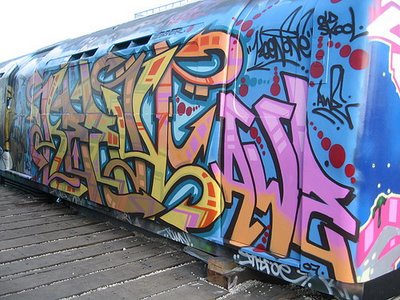
Is graffiti art, vandalism, or both? The bright colors and designs that cover the streets' walls may look appealing to the eye, but also a sign or gateway to petty crime. According to Jeanna Bryner's article: "Graffiti Triggers Crime and Littering" graffiti that is present in the public increases the crime and litter rate. A group of researchers did a few experiments to test out this theory, which in fact, turned out to be true.

A passage from Jeanna's article tells us some of the experiments the researchers did:

"In two other experiments, the researchers found that graffiti and litter can lead to stealing. They stuck an envelope that contained cash partway into a mailbox so that passersby could see the envelope and the money within. In one scenario, graffiti covered the mailbox. And 25 percent of passersby stole the envelope from the graffiti-covered mailbox, while just 13 percent stole from the clean mailbox.When litter was scattered around the clean mailbox, nearly 30 percent of passersby stole the envelope, compared with the 13 percent in the litter-free and graffiti-free scenario."

In another article that I have read, the author dives into the modern day perspective of graffiti. Killian Tobin states that graffiti started off as a form of artistic expressions from young people. It was a way to get kids, especially young boys, to show off their artistic skills and thoughts to the world, until it started getting onto the walls of private property owners. This is where things got out of hand when graffiti artists had to compete for space and private owners were offended by their markings. They started to categorize artistic graffiti as gang graffiti. It is very unfortunate that something so beautiful could have a bad reputation because of what other's judge.

 
"Artistic Graffiti" 
This is art.


"Gang Graffiti"
This is not art.

I, too agree that this form of art grew into an activity that vandalizes personal space of a private owner, but I don't think people should be scared every time they see a design or a basic word written on the wall. Spray painting art in the public may be illegal, but it won't stop those who rebel against it from expressing themselves to the public.

Though graffiti is a crime, it is still art. Maybe we should try covering up those gang signs instead.


Wednesday, March 20, 2013

Words of Art (poetry)

Roses are red, violets are blue
What is poetry to me and you?

   Poetry, in actual definition, is the literary work in which special intensity is given to the expression of feelings and ideas by the use of distinctive style and rhythm. It is a way to write out one's thoughts and emotions to relieve an internal conflict, whether it's positive or negative. When people think of poetry, they often think of it having a rhyming scheme. This does have a lot to do with poetry, but this is not always the case. My previous English teacher once told me that poetry has no rules or regulations; it comes from what you think is poetic and expressive from your own mind and heart.

   How can one understand the basics of poetry or even make it? Well, poetry is broken down into many different elements, just like how art, in general, is divided into many parts. According to the Lifestyle Lounge in their article The Basic Elements of Poetry, the main elements of poetry are:


  • Theme
  • Symbolism
  • Meter
  • Rhythm
Other elements include:

  • Rhyme 
  • Alliteration
  • Simile
  • Metaphor
   I've also stumbled across an interesting slide-show on Google where they included personification and repetition as other forms of elements. The list still continues because again, poetry has no specific rules or regulations; it can be composed with a lot of things.


 "To climb steep hills requires slow pace at first."  -William Shakespeare


   A couple of my favorite poets are William Shakespeare and Emily Dickinson. Shakespeare is well-known across the world and has composed over a hundred of poems in his lifetime. Majority of people are familiar with his famous plays Romeo and Juliet, Hamlet, and Macbeth. The quote underneath his picture above is one of my favorite quotes by him. It is a simple statement that means so much and can be used for motivation in any situation in life.

Emily Dickinson
   Emily Dickinson is another one of my favorite poets because she was a private poet and lived a reclusive lifestyle. I find that interesting because I'm the same way, but with my poetry. I never seem to share my poems and I keep them locked away. What's unique about her poems is that they often lacked titles, contained short lines, and used unconventional capitalization and punctuation. This is specifically why I believe poems should not have any restrictions. Emily did it without a care and all because she was expressing herself and was not doing it for any reward or "academic writing skills".


   As an artist, I am a very sensitive and expressive person. I've previously stated that I express myself through my art and poems. This poem was constructed by me some time in the beginning of the year 2011. The poem in entitled "Dead" and it is based of a heartbreak that I have experienced in the past.

"Like a dying rose your words still untold
As my heart squanders and tries to unfold
Your presumptuous heart is highly elated
While my heart is truly devastated 
Will be dead.
Your love, evanescent, was very inconspicuous and brash
The burning flames confiscates my lungs with the burning ash
But my own solicitude for my fervent heart will stay
As your delusions and lies will be vanished away
Beginning to be dead
Looking back at the memories but on a new quest
My spirit is ascending, and my mind is more deft
As my journey comes to an end, I've finally arrived
You're still buried in your lies, because you never even tried
Dead."

   Words are beautiful, and poems say so much with just a few lines. Reading them, and picturing it can really make a person feel the pain or happiness of the writer.

Wednesday, March 6, 2013

Oil Pastels

Using crayons and chalk can be fun, but using oil pastels are even better! Oil pastel is a painting and drawing medium with characteristics similar to pastels and wax crayons. Oil pastels consist of pigment mixed with a non-drying oil and wax binder, which makes it more difficult to blend than "soft" or "French" pastels. Soft pastels are more powdery then the oil pastels.

The history of oil pastel is quite interesting and started off in 1921 where two brothers-in law created a crayon that combined the soft, smooth color application of crayon with the brightness of pastel. In 1947, artists Pablo Picasso and Henri Goetz decided to make a more professional version of the product. According to The Oil Pastel Society, Picasso convinced Goetz to create a medium in which he can use on anything without having to prepare or prime a canvas. Two years after, in 1949, Henri Sennelier invented the first professional oil pastels with the help of Goetz and Picasso. The history of oil pastel continues which is available on few websites like The Oil Pastel Society.

Greg Albert wrote in his article "Painting with Oil Pastels for Beginners" about different tips and techniques to use when working with this form of art. Some techniques he has stated here are:


  • Underpainting
  • Cross-hatching
  • Blending
  • Layering and impasto
  • Scumbling
  • Scraping
Oil pastels can be used on any surface, so drawing on top of acrylic paint, or even water color can bring out the different shades of colors and leave a visible background. This process is called underpainting. Cross hatching on the other hand is an artistic technique used to create tone or shading effects by drawing closely spaced parallel lines that cross each other. Blending oil pastels is a bit difficult to do because the medium is so wax-like, but this can be done by using paper towels or blending sticks. Layering and impasto is important in oil pastel paintings. The word impasto refers to a technique used in painting, where paint (or other medias) is laid on the surface very thickly. Having thick layers can lead to other techniques like scumbling and scraping that provides a broken, speckled, scratchy color over another color. This technique shows the lower layer of color.The result gives a sense of depth and color variation to an area.

Other sources of using different techniques in oil pastels are YouTube videos. This artist in this video, Oil Pastel Techniques: How to Color with Oil Pastels mentions stroke work and how to move and blend in the direction of the picture. She demonstrates few tips like highlighting and contrasting the picture to give it a more vivid look.

After reviewing these few techniques, I did a little experiment on my own. I have once worked with oil pastel in the past, so I compared my old drawing to the one I recently completed, using some of these tips.

I've noticed that I used an extreme amount of color to create this landscape. Now since oil pastel never dries, I went back and added the scraping effect in the corners of the page.

My blending in this oil pastel painting is way better than the first painting. I used scumbling/scraping, a little bit of stippling, and blending to create this drawing. The hardest part of the drawing was blending the colors in the water to give a reflection look.

Working with the product is pretty simple. It may be difficult to use for others, but it's easy to work with and to create originality in a painting or drawing. During my senior year of high school, my art teacher gave us an assignment to imitate a landscape using oil pastels. I personally disliked it at first because the drawing looked nothing like the original picture. Another thing that made the project even more difficult was the fact that we could not use the color black. These restrictions ultimately stressed me out, but it dawned upon me that we are only imitating and using the picture as a reference. Using oil pastels can help an artist become more colorful and original with their works because its almost impossible to make the painting look exactly like it's original/reference. 


Wednesday, February 27, 2013

The Graceful Art

What is dance?
   Dance is a form of art where the body moves rhythmically to music.

Why is it a form of art?
   Dance is self-expression and so is art. When a person dances, they are dancing out of fulfillment and satisfaction. It is their own way of expressing their mood and letting the body become free to express one's emotion. The human movement becomes the medium for understanding, sensing, and communicating ideas, feelings, and experiences.

   Dance is broken down into different elements in this worksheet found in the Dance Education Curriculum Guide. These elements, also known as BASTE, can help a person look deeper into the art and get a full understanding of the passion of dancing. These elements include:

  • Body
  • Space
  • Time
  • Action
  • Energy


   Walter Terry commented, "No paints nor brushes, marbles nor chisels, pianos or violins are needed to make this art, for we are the stuff that dance is made of. It is born in our body, exists in our body and dies in our body. Dance, then, is the most personal of all the arts . . . it springs from the very breath of life."

Jo Murphy also describes in his article The Elements of Dance from MPS Arts Rich Community the concepts of BASTE and the art of dance.

   The movement of the body in dance is the mobile figure or shape that is seen by others, and felt by the dancer. First time dancers may be a little stiff in the body and not look right while they dance around, but professionals knows how to move, when to move, and create a move, which causes them to dance so gracefully. When I used to take ballet classes, my teacher taught us that the dancer shifts from the inner realm (ideas, intentions,emotions, identity) to the outer realm (expression and communication) of the body continuously.
Fabian Perez "Tango II"

   The space and surroundings of the dancer is an important thing to observe. Have you seen a choreography and it just didnt' look right? Maybe the spacing between the dancers were too wide or tight, or the setting didn't even match the concept of the performance. This element is important because the amount of space the dancer uses catches their audience's attention. Although axial movement can be very unique and eye-catching, I personally would not want to watch a dancer stand in one spot during the whole performance; it kind of gets boring. Objects and scenery complements the dancers and give their performance a beautiful effect. It helps others to visualize and feel what the dancer is feeling.

When hearing the word time, often you think of the word "when". Time plays an important role in dancing. Time is the speed and duration of the movement. There are the metered, free rhythm, clock time, and riming relationships. The dancer could dance slow then pick up to a faster rhythm, or their performance could be long of short. Time is used differently when it comes to dancing. Dancers may take cues from each other to start the next step or use a shared sense of sensed time to end a dance all at once.

Action and energy of dancer brings liveliness within their performances. Actions can include a dance step, a gymnastic flip/toss/turn, or even a facial expression. Action for dance does not always require moevment; it can be shown through a pause in the routine and the stillness of the face.

In dance, there are two types of movement that can be combined.
  • Locomotor (travelling through space)
  • Non-locomotor (axial movement)
Dancers also use energy to keep things moving and alive, and also for lifting weights of other dancers. Energy enhances the actions of the dnacers, providing a remarking performance.

This form of art also has many different styles and genres. Some include ballet, ballroom, tango, break-dancing,stree-dancing, tap dancing, etc. The long list of different types of dancing continues, but they all share on common thing, which is sharing the expression and passion of the dancer.


Works Cited


Terry, Walter (1942) . Invitation to Dance. New York: Barnes, 16.

Murphy, Jo. "Developing an Understanding of the Principles and Elements within the Creative Arts." Suite101.com. Suite 101, 16 Dec. 2012. Web. 27 Feb. 2013.

Mirus, Judith. "The Elements Of Dance." Selections from the Dance Education Initiative Curriculum Guide. Golden Valley, MN: Minnesota Center for Arts Education, 1994. N. pag. Print

Wednesday, February 20, 2013

Illegal Art? I think not!

   Many people believe that graffiti isn't art, and more of vandalizing a building or street wall. Well, technically graffiti is a form of art the captures the different shades of colors and angles.


   Society see's graffiti as a form of defiance towards them, even though it is a form of contemporary art. "The first modern graffiti writer is widely considered to be Cornbread, a high school student from Philadelphia, who in 1967 started tagging city walls to get the attention of a girl. But it was only in the 1980s that galleries began to showcase graffiti as artwork." (Melker, Saskia) The places you can see heavy graffiti culture is New York, Chicago, Philadelphia, and Detroit. There are many other sites but the area where graffiti is accepted, as a form of art is Europe. The Europeans do not see graffiti as a form of vandalism; they see it as a form of art. Back in the 70s you would see graffiti on the Subway trains a lot. The reasoning the trains were targeted was so the artist work can see all day wherever the train would travel.

   Overseas owners really don't mind seeing graffiti up on their building walls. They see it as dead space, why not put up abstract or beautiful artwork up to help the building stand out. In Toronto, there is a case about whether or not the graffiti should be taken down or not. They see this as vandalism; the funny thing is that the owner of the building doesn't mind it being there. It is just so said that the world casts out graffiti. The only reason it is cast out is because many misunderstand it. Throughout history society tends to judge things they can’t nor are willing to understand.


   Who are we to say graffiti isn’t art? Art is like water. I say it is like water because water is a versatile element it can take the form of anything. Art has many different forms.

   Graffiti itself has different styles there is not one style, so you can say it's very versatile. To me I really can't say putting art on a wall that is just abandoned and taking up space is vandalism. I feel like if its not being used put graffiti up let the world no only see your artwork but bring life to the area.


    If society can't accept graffiti as a form of art then that means their view on art is one-dimensional. I would understand how the community would feel if kids just tag places without asking but if they want to stop it then open up a spot for them. I feel if they have a place where they can exhibit their graffiti or art they would stay out of trouble and be more respectful towards the community.

   If society accepts graffiti there will be no conflict with the community and the artist. Open doors to artist to exhibit their skills and it will have a positive reaction towards the community. I feel and will always feel Graffiti is art and I just wish the world wouldn't label it as vandalism.

Works Cited
Melker, Saskia. "History Of American Graffiti: From Subway Car to Gallery." PBS. PBS, 31 Mar. 2011. Web. 20 Feb. 2013.
Humber, Larry. "The Art Newspaper." The Art Newspaper. N.p., 07 Nov. 2012. Web. 20 Feb. 2013.

Wednesday, February 13, 2013

   This is just a quick entry that I want to share with my circle. Last Halloween (October 2012) I decided to get a little creative and go all out my way with my artsy side. I YouTubed a tutorial on how to do a sipper effect for Halloween. Being motivated to become something scary led me to my success of getting many compliments that night. "Your costume is scary as hell." said a customer at Walmart.
"Thank you, that's what I was aiming for."

   Materials needed to make this costume were:

  • Red face paint
  • A skin complexion zipper
  • Spirit gum
  • Black eyeshadow
  • Petroleum Jelly
  • Fake blood
  • Foundation Make-up

"Zipper Face"

   The looks on many people's faces were priceless, especially since I walked around with a straight face half the time. Many people were appalled and I enjoyed every bit of terrified look. I scared a lot of people that day.

(Two entries: February 13, 2013)

Dusty Art

   Have you ever seen a chalk drawing done on the streets or the sidewalks that we walk on? If so, did they appear three-dimensional to you? Chalk drawings are a beautiful form of visual art that anyone can use. Chalk is a great drawing medium for anyone because it can be used on sidewalks, walls, paper, and other media.

Larimer Arts Association (2012)
 
  "The creation of a chalk painting takes many hours and is often not as simple as it seems. First, the artist must draw an outline of the original painting in proper proportion using pencil or a charcoal pastel. Then they begin to lay the base of colors. Using a number of colored pastels, the artist layers the chalk, blending the colors to create shadow, contrast, and depth. So one might ask, ‘why street paint when the artists’ efforts disappear immediately?’ As avid street painters will tell you, this is performance art, where the process of creating the work is more important than the finished piece. For many, the dialogue with spectators can be as rewarding as creating their masterpieces. People can view the work in all stages of progress, from layout and design, to applying colors, to the finished creation."


   Street chalk has to be the most interesting form of chalk drawing. They can be used for advertisements on university campuses, for elementary schools to play games, or even for creating new fun art for people to enjoy. Artist like Tracy Lee Stum make these paintings on the pavement and create an optical illusion to the audience's eyes.


3-D Street Chalk Art done by Tracy Lee Stum

   What I like about Tracy's work is that when she draws, Its freehanded. Stum stated,"I tend to work intuitively, often creating or developing each painting in the moment- I may not know exactly how it will look before I begin but I listen to my impulses and find they always led me to wonderful discoveries and results." I've always had a problem of drawing things from my imagination, so her being able to do that full-effect of 3-D drawings from her mind is phenomenal. Tracy was also a featured artist in the Artizen Magazine in their "Chalk It Up" article.

Tracy Lee Stun, and other artists, is in fact an actual street painter; it's her job. In this video, she speaks about her life as a street painter and also mentions that the beautiful form of art only has a life span of a few days! Why would an individual consume so much time in something that won't even last forever? Well after watching her video, Tracy does what she does simply for the enjoyment and satisfaction of other. Street art became apart of her and it allows her, and other artists to come out the isolated room and share the creativity with the public eye.


    Chalk art festivals occur in places like Denver where people can enjoy the beauty of chalk. The Denver Chalk Art Festival is a free two-day street-painting festival where more than 200 artists spend hours that weekend turning the streets of Larimer Square into a museum of chalk art.


   "Resting Place" by Khadija Azzam (me)
Crayola Chalk

"In Love And Death" by Khadija Azzam (me)
Made for my sister Julie
Crayola Chalk


"Sunset" by Khadija Azzam (me)
15 mins worth of time, Crayola Chalk.


"Dragon" by Khadija Azzam (me)
Crayola Chalk
11 hours; First Chalking Drawing of 2013


   Experiencing with chalk was very annoying at first and a challenge, until I finally mastered it. I first did a chalk drawing in my art class in high school, sophomore year. I hated it a lot because it was so hard to stay in the lines when the edges eventually becomes dull. My trick to staying in the lines is to continuously break the chalk so that the edges remain sharp. Blending the chalk on the paper would have to be the easiest part because chalk is dust and it smears smoothly. After three years of practice and dedication to art, chalk art has become my strongest point in drawing.


Works Cited

Becker, Kirsten. "History of Chalk Art." Denver Chalk Art Festival -. Larimer Arts Association, n.d. Web. 13 Feb. 2013.